Society Needs Drastic Change
I remember being a kid, growing up in a small house in a sleepy suburb of Washington state, where my greatest troubles were losing my action figures while playing with them in the backyard, or my mean brother ripping my bookmark out of my book, losing my place and having to leaf through the book to find it again. Life seemed so small and kind. It was often boring, and in some ways stifling, but in general, good.
I was not a good kid, but in the back of my head I believed in a path to a bright future if I applied myself, I saw justice in the world around me, and the evils of the world felt like distant tales of ages past. I may not have had much character, but the world around me seemed to be good. It seemed a kind, gentle world, where the most serious problems were grappled with far away, and they were the exception to an otherwise orderly world of science and reason.
I had heard common complaints of flaws in my culture – greed, corruption, carelessness, but to me those things seemed inevitable and perennial, how could I expect a world to exist with only good people? There would always be some bad people getting away with foul deeds from time to time, I thought, the existence of such things doesn’t amount to cause for alarm or talk of deep, foundational issues.
Sometime in my teen years I made a transition from immature and without notable morality to mature and driven by integrity. Shortly after I attended university and began cooking for myself and managing my own affairs (well, it was a small studio apartment that I did not pay for, so perhaps it is an abuse of the term to say I really had affairs to manage, but it was the first time I was mostly independent). It was around this time I became more aware of where my food was coming from. I had somehow always had, in the back of my mind, the idea that the animals that I ate were not treated well, and I had to be careful of where I got my meat if I wanted to do my best for them.
I can’t exactly say where I got this inclination, probably I had seen a certain documentary or heard people talk of what modern farms were like. I ate vegetables and tofu a good deal, and tried to cut meat out of my diet, or at least reduce it, but eventually figured it was impractical, and thought I may have overstated the concerns about where the meat available to me came from anyways.
When I was young my family would visit relatives that lived in a rural area from time to time. The drive out to see them was a couple hours and on the way we would pass by many farms. I would see all sorts of animals, but mostly horses and cows, grazing listlessly in large, open, grassy areas with boundaries drawn by short wooden fences. These images stuck with me as I grew up so I always had the impression that at least some of the meat that I bought came from animals that lived in places like this.
Or at least I thought that there would be a larger scale version of these types of farms somewhere, perhaps a more industrial version of the farms that I saw growing up where there were hundreds of cows in a much larger, but still grassy and vast, outdoor space, or perhaps some cleverly managed, tactfully automated, network of smaller farms.
I think this was a pretty reasonable thing to think. Given my experience of the world and what I knew about animals and business it was not unreasonable for me to imagine that most of the meat I got came from animals who lived in such a situation. Even though I believed this I still had reservations about meat that came from these set-ups. I thought it risked being unnatural and depriving the animals of the basic qualities of life they would have in nature – the freedom to roam, find partners and raise their young.
It was unthinkable to me at the time that much of the meat available to me came from animals who were crudely genetically modified to be easier to slaughter at mere weeks old, who were slaughtered at weeks old after being crammed into filthy, dangerously dirty, dark, warehouses where they lived for a measly five to six weeks at most, if they didn’t succumb to excruciating disease from the filth or disfigurement from the genetic modification (which many would).
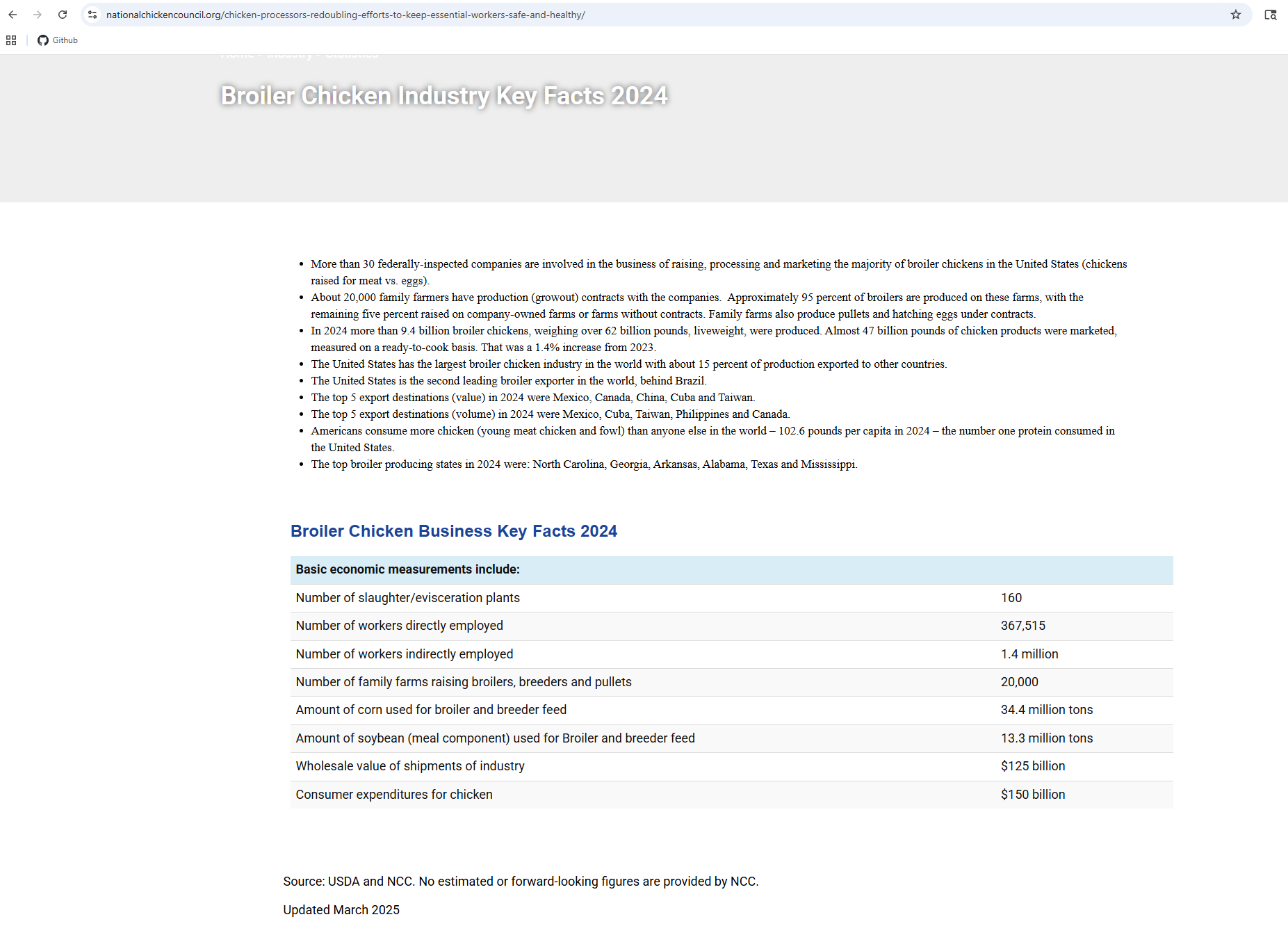
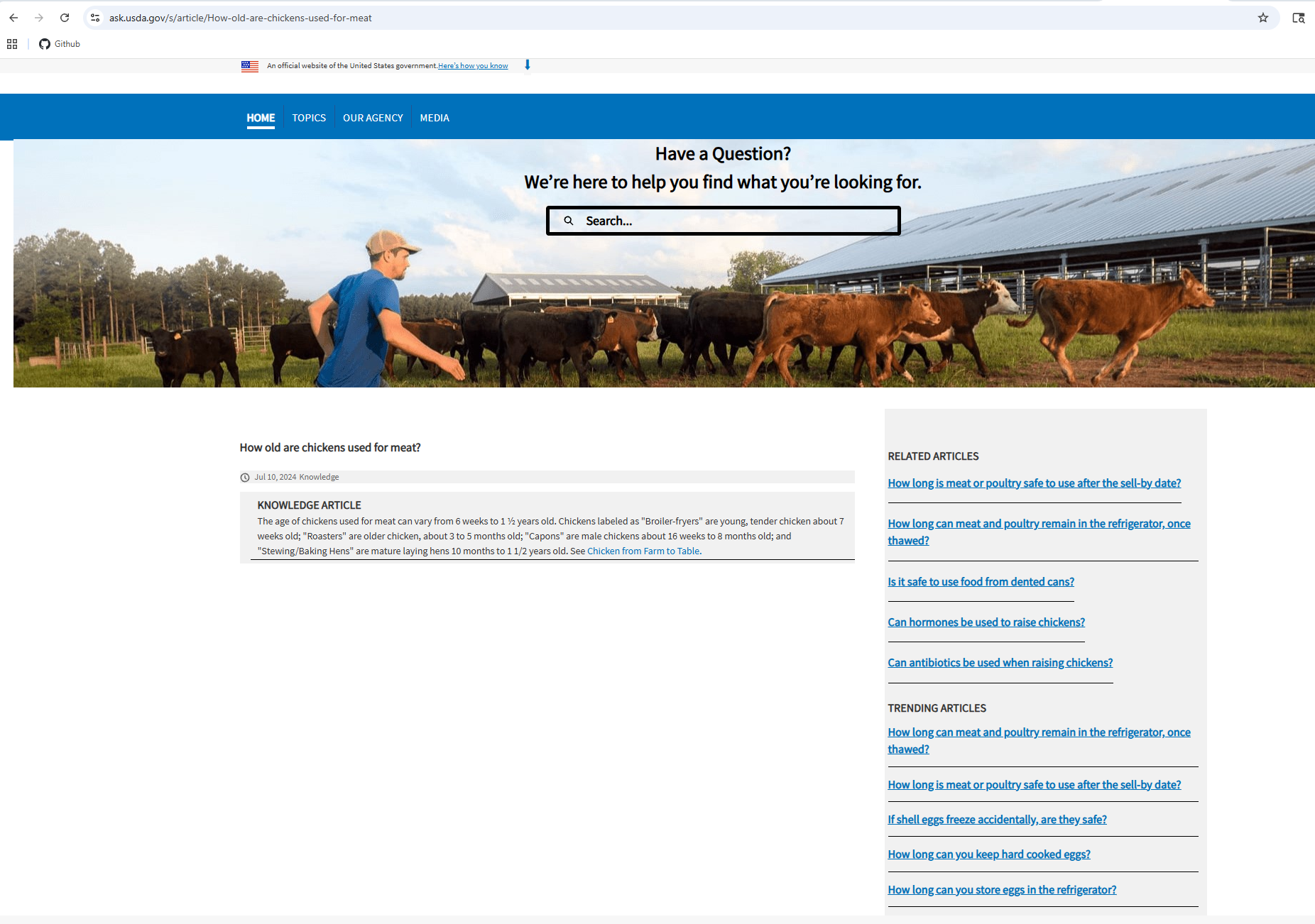
This is, in fact, how nearly all the chicken available to US consumers is raised. If you were to try to imagine the scale of the situation, and you imagine it as large and terrible as you possibly could, you would not be imagining it bad enough. In 2024 alone, more chickens were produced to be slaughtered at the age of five to six weeks old than there were humans on earth (number of chickens raised: https://www.nationalchickencouncil.org/chicken-processors-redoubling-efforts-to-keep-essential-workers-safe-and-healthy/, age chickens slaughtered: https://ask.usda.gov/s/article/How-old-are-chickens-used-for-meat). 9.4 billion chickens, to be exact.
The number I cited above did not come from an advocacy group or animal rights organization. It was produced by a report from the National Chicken Council - a trade organization (non-profit organization composed of businesses involved in the production of chicken) advocating on behalf of the chicken industry.
The conditions chickens raised for slaughter live in, mentioned above, is a well-established fact and can be verified with online research, as is the age that such chickens (called “broiler chickens”) are slaughtered. None of this information is disputed. Setting aside the tortures that await these poor souls, a troubling fact remains. The world, in its current state, has evolved through the twists and turns of science, industry and culture to create a condition such that an entire species of creature no longer lives in a way where they have any earthly purpose of their own. Their entire existence, all of its subtleties and complexities, all of its natural endowments, all it’s beauty and struggle, has been usurped and completely subordinated to the whims of another. The fact that such a thing is even possible is deeply troubling.
What would humans do if they were to face an invasion by an alien species who intended to confine them, deprive them of their basic capacity for applying their natural skills, remove them from their environment, remove their ability to seek partnership and love and remove their capacity to build families and pass on the product of their determination, grit and ingenuity to the next generation? What would humans do if they were helpless to stop such an invader?
And what if such an invader could not even be prevented from making whatever was left of their short, painful, desolate lives as miserable as worldly possible? And almost all humans were kept in these conditions for decades with no end in sight. The scenario that would unfold would be more terrifying than any horror movie that could ever be produced.
And yet it is the reality that our society has created for innumerable, literally billions upon billions, of lives.
But this blog isn’t about animal rights or the meat industry. The example above is just one example of what the structures in the world around us have done. And truly for much of my life it was unimaginable to me. The treatment of chickens in industrial farming is a stark example of the abhorrent realities that come when the vulnerabilities of modern social systems are exploited. But you might think periods of times where social systems fail, and treachery ensues, or imperfections of social systems which enable horrid abuses, albeit in limited ways, certainly aren’t new phenomenon and must be challenges humanity has faced since the dawn of civilization.
It could be tempting to see problems similar in scale and nature to the ones described above and think that they are the same age old flaws that any civilization will run into, just part of the business of living in a social system, things that are impossible to fully eradicate, bound to be always present to some degree, and limited enough in nature not to see as generalized or foundational problems. My point in this blog is that this is simply not true.
What has happened to our delicate and vulnerable feathered friends is only possible because of the incredible scientific and engineering achievements of the past few centuries. It is these achievements, fundamentally a product of society, in conjunction with changes in the way which we organize ourselves and manage our lives, that makes these things possible. Our technology has grown remarkably but our ways of living together have not.
We have entered into a new era of unprecedented social challenges. Our social systems, the laws that we choose, the traditions that we create and the ways in which we relate to one another and our environment, are all very real and tangible things. And in this new era they are the only things that can stop unimaginable abuses like those described above.
It’s easy to look at the state of the world, or try to imagine the scale or nature of the problem I mentioned earlier, and feel a great sense of anger at the shocking iniquity. In some ways this is not unfair to think. But the treachery done by the people who have deliberately brought the world to its current state is only one part of the story. The story of modern life is a story of how the things that have made such horror possible have come to be. It was not nature that allowed the circumstances to come about that have relegated the billions of beautiful creatures that once roamed free in the wild, living rich, full lives to their current abyss of torture and servitude.
Great power has come to the hands of humanity, through ages of science and engineering. And that great power is gated only by our social systems. For those systems to be effective they would have to assure the products of our society, and the power they equip us with, is only put to good use, and used wisely and humanely, and not accessible to the cruel or negligent. Moreover, the system would have to assure this even when there are many within it, even a majority, who wish it were not, or who don’t do what’s necessary to assure it is not. And that would have to be assured without removing personal freedom.
That is quite a task, and our social systems are just not there yet. Instead what we have seen is that the systems that we have created to organize our lives have severe, catastrophic vulnerabilities, and at the same time we have developed, and continue to develop, incredible technical breakthroughs that equip those systems with fundamentally new, and greater, powers.
And it is this state that even makes it possible for the cruel amongst us to see their will done in such wide ranging fashion. And it is this challenge that must be overcome. If I were writing this blog in another time I would probably say something like it is this challenge that must be overcome if we are to see brighter days, or to find freedom, or to have hope for love, or science, or reason. But I don’t think that’s appropriate. I think the only appropriate statement is that this challenge must be overcome. If it is not, there will be nothing left for us to speak of, and no life left for humanity to see through its days.
So long as the same reasoning that has been applied to condemn our feathered friends is applied anywhere in the structure of our societies, an unbreakable chain of fatal consequences marches ever closer.
It is a terrible and bizarre thought that there is some solace in the fact that the world as we know it will either change or cease to be. And it is with a heavy heart and mind that I think these things and write these words, and with a great longing I wish I could end this blog with a lighter, happier sentiment. But I know that I am not the only one who finds the rejection of the reality of the circumstances facing humanity today untenable.
I wrote this solely because I think a stark reality check is necessary, and dramatic change is imperative. It is very difficult to write something like this, or to even begin to imagine the treachery that has been done in this age. And yet as important as it is to realize how bad things have become, it is similarly important to realize how unusual it is for things to be this bad, and how they do not define life, but rather show that strange, severe and difficult to predict new challenges have arisen as a new age has dawned.
This brief time of suffering is passing, and will never be normal. But living in this time presents us all with a set of choices with unusually significant and extreme consequences.
Life itself is not bad and never will be, but we can be. And a world where the impact of humanity’s worst instincts are amplified significantly by the structure of the world around us is a very dangerous world. It is a world where our collective ability to remain an inhabitant of this earth rests in our hands. That is a stunning and unprecedented responsibility and there is no certainty we are living up to it and many indications we are not.
It is a hard truth, but an important one. Still, as dark as it is to imagine, there is some peace in knowing life remains in the hands of forces greater than us, and will continue no matter our fate. As hard as it is to live through this time, there remains a profound sense of peace that can be found by reflecting on the story of nature.
Nature will not be broken by our will. Life on Earth has persisted through drastic changes in the environment. As ancient as the evil that haunts us now must be, so too is the wisdom that has carried life through innumerable ages. I remember, on a walk the other day, I was passing through the downtown area of the city I live in and saw that a plant that grew outside a shop near where I live was blooming, and it had grown almost as high as the top of the building near it, in just a short few months.
It was about 25 feet tall. It was remarkable, and it gave me a great sense of peace by reminding me of the timeless majesty of nature, and how life can find a way to persist in even the most dire of situations and inhospitable of places.
And yet it was unfortunate, the stark contrast between this resilience and the story that I was piecing together in my head about what the world of humanity that surrounded me had become. I had not then and never will lose hope, but the realist in me was nagging me to find a way to rationalize what the future might look like with what had come to pass.
What troubled me, deeply, was that no matter what I thought, or how I reflected on the direction of the world around me, I found it impossible to ignore the fact that the world of humanity did not seem to be correcting itself. Instead, it was worsening, the vulnerabilities in our social systems and the practice of their exploitation were spreading, all the while we marched, on the shoulders of giants, restlessly closer to twilight.
The world is indeed in need of drastic, fundamental change. Nature is patient, but not permanently, and it forgives, but not easily. There are now thresholds we can cross that there will be no coming back from. The world of humanity will not continue in it’s current state. If we cannot rise to the challenges of the modern world, the story of life on earth will have to continue without us.
Figures
A screengrab of the numbers referenced above, in case the sources change / disappear.
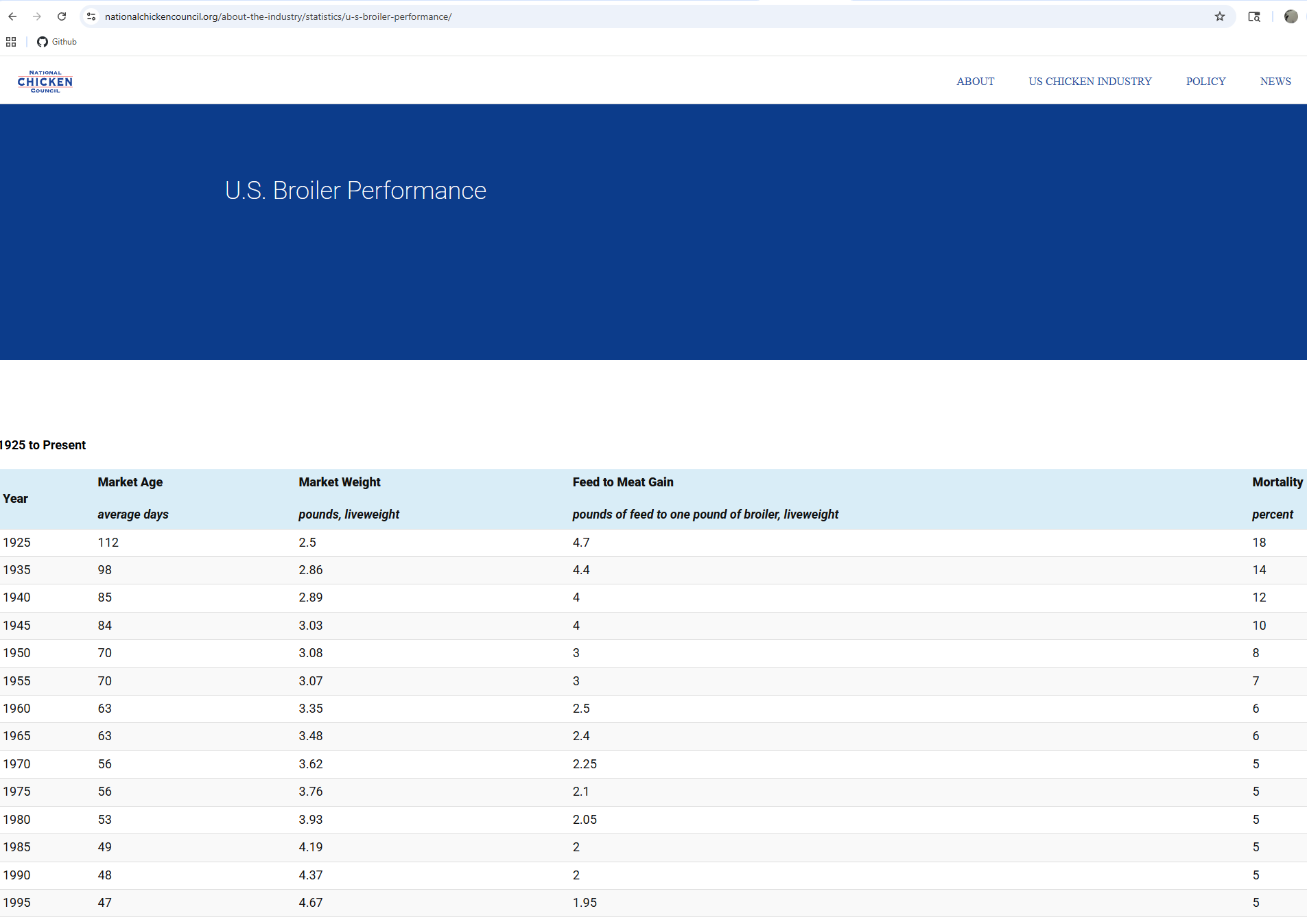
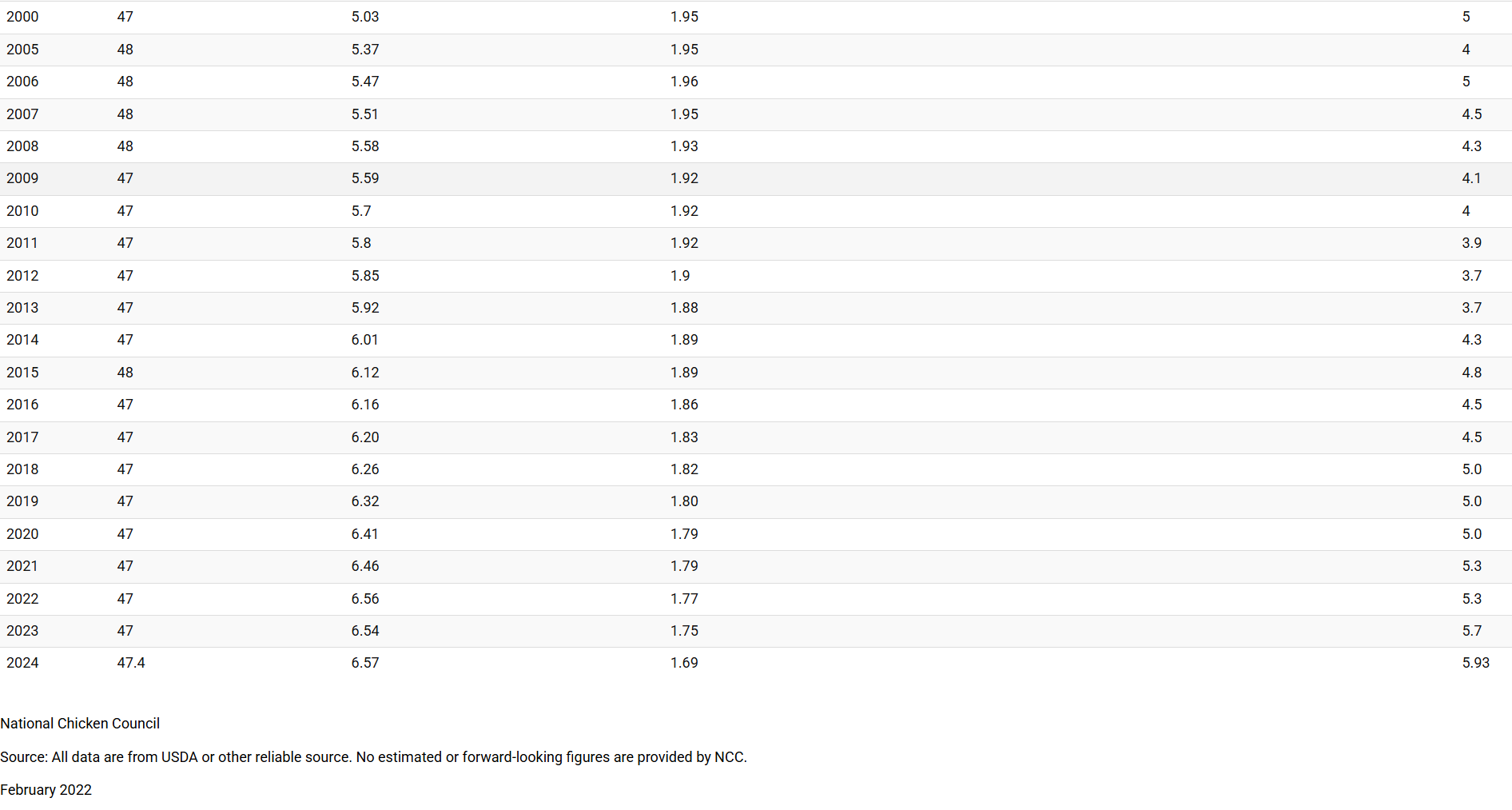
You can see a statistical summary, also provided by the NCC (National Chicken Council), of what has happened to the chicken in America https://www.nationalchickencouncil.org/about-the-industry/statistics/u-s-broiler-performance